
Restorative dentistry
Dental Crowns in Turkey
A full cover for a tooth that can no longer hold itself together on its own.
Suitability depends on an individual clinical assessment — nothing is decided before you are examined.

Ask for a call back
Leave your name and number — the clinic calls you back.
Thank you. The clinic will call you.
Your number has reached the team in Alanya — your reference is . If it is easier, you can write on WhatsApp instead: Open WhatsApp
Your number could not be sent
Nothing was received, so please try again — your answers are still in the form.
About the treatment
What a crown does for a tooth
A dental crown covers the whole visible part of a tooth weakened by a large filling, a fracture or root canal treatment. It is made to fit the prepared tooth and restore its shape and function. Whether a crown suits you depends on an individual clinical assessment.

A filling relies on the tooth for strength; a crown lends strength to the tooth.
A filling replaces part of a tooth and depends on the walls around it for strength. A crown works the other way round: it covers the whole visible tooth, so the crown carries the bite and holds what remains underneath together. That is why crowns are usually discussed after events that weaken a tooth — a large fracture, a very large filling, or root canal treatment, which can leave a back tooth more prone to splitting.
To make room for a crown, the tooth is reduced in size all round, so some healthy structure is removed. This cannot be reversed: once a tooth has been prepared for a crown, it will always need a covering of some kind. For that reason a crown is weighed against smaller options, such as a filling or an onlay, and is proposed only where your dentist judges that the tooth needs the extra protection.
“Crown” describes the design, not the material. Crowns can be made in different materials, and the choice depends on where the tooth sits, how much load it takes, how visible it is and whether you grind. Porcelain surfaces are often chosen where appearance leads; zirconia, a metal-free ceramic, is often chosen where strength leads. Your dentist will explain which material is proposed for each tooth, and why.
Who may consider it
Who may consider dental crowns
A crown may be discussed when a tooth has lost more structure than a filling can reliably replace. Only an examination can show whether that applies to you.
Treatment suitability depends on an individual clinical assessment. Your dentist will discuss the options, risks and expected outcomes with you.
-
01
A tooth that has broken
Where a large part of the tooth has fractured and too little sound structure remains for a predictable filling.
-
02
A very large or repeatedly replaced filling
Each replacement tends to remove a little more tooth, and at some point a covering may protect it better.
-
03
A back tooth after root canal treatment
Root-treated back teeth can be more brittle, and a crown is often recommended to reduce the risk of splitting.
-
04
Worn or misshapen teeth
Where wear or an unusual shape affects function, and a more conservative option would not be enough.

Benefits and considerations
What it can offer, and what to weigh up
Balanced information, because the right decision depends on both.
What it can offer
- Protection for a weakened toothBy covering the cusps, a crown can help hold a damaged tooth together under chewing forces.
- Restored shape and functionThe biting surface and the contacts with neighbouring teeth can be rebuilt.
- A choice of materialsThe material can be matched to the position of the tooth and the load it carries.
- Shade planned with youColour and shape are agreed beforehand, with the aim of blending with the neighbouring teeth.
What to consider
- Irreversible preparationHealthy tooth structure is removed to make space, and the tooth will always need a covering afterwards.
- The tooth underneath can still decayThe edge where crown meets tooth needs careful daily cleaning and regular check-ups.
- Not every tooth can be crownedIf too little tooth or root support remains, other options such as extraction and replacement may be discussed.
- Nerve reactionsPreparation can irritate the nerve, and occasionally a crowned tooth later needs root canal treatment.


Step by step
How the process works
A crown is usually made over more than one visit, because the tooth is prepared before the crown itself is made. Your plan is agreed after the examination.

-
Step 01
Examination and X-ray
Your dentist assesses what remains of the tooth, the root and the supporting bone, and discusses alternatives.
-
Step 02
Groundwork where needed
Decay is removed and, if the tooth requires it, root canal treatment or a core build-up is completed first.
-
Step 03
Material and shade
The material is agreed for that tooth, and the shade is chosen with you, ideally in natural light.
-
Step 04
Preparation and impression
Under local anaesthetic, the tooth is shaped to make room for the crown, and an impression is taken.
-
Step 05
Temporary crown
A temporary cover protects the prepared tooth while the final crown is being made.
-
Step 06
Fitting
Fit, contacts, bite and appearance are checked before the crown is cemented or bonded in place.
-
Step 07
Review and aftercare
The bite is re-checked and you are shown how to clean along the crown margin.
Side by side
Porcelain or zirconium: how they differ
Both are crowns; the difference lies in the material and where each tends to be used. Your dentist may suggest different materials for different teeth.
| Porcelain crown | Zirconium crown | |
|---|---|---|
| Material | Porcelain surface, over a metal or ceramic core | Zirconia, a dense metal-free ceramic |
| Chosen mainly for | Appearance, depth of colour and surface texture | Strength and resistance to fracture |
| Often used on | Visible teeth under moderate biting load | Back teeth, heavy bites and bridge frameworks |
| Appearance | Layering can closely imitate natural translucency | More opaque; translucent types narrow the difference |
| Points to discuss | Porcelain may chip with grinding or heavy load | Hard surface needs careful polishing and bite adjustment |
| Metal content | Depends on design: metal-based or all-ceramic | None |

Real results
Cases the clinic has shared: porcelain crowns
Each image is the clinic’s own before-and-after composite, shown exactly as supplied. Results vary between patients and depend on an individual clinical assessment.
See all before and after casesMore results on Instagram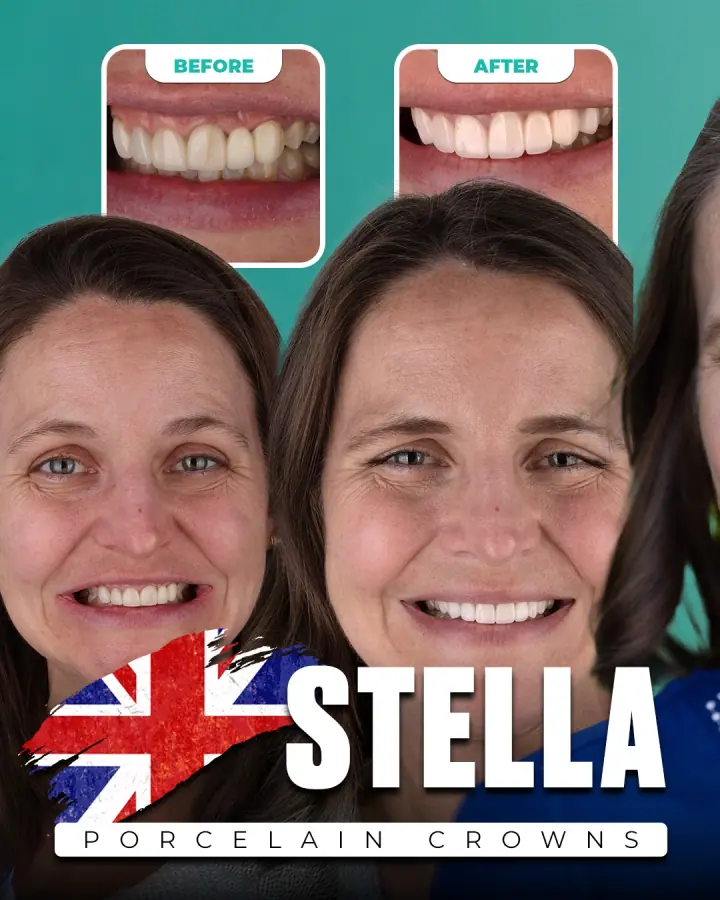
StellaUnited Kingdom · Porcelain crowns 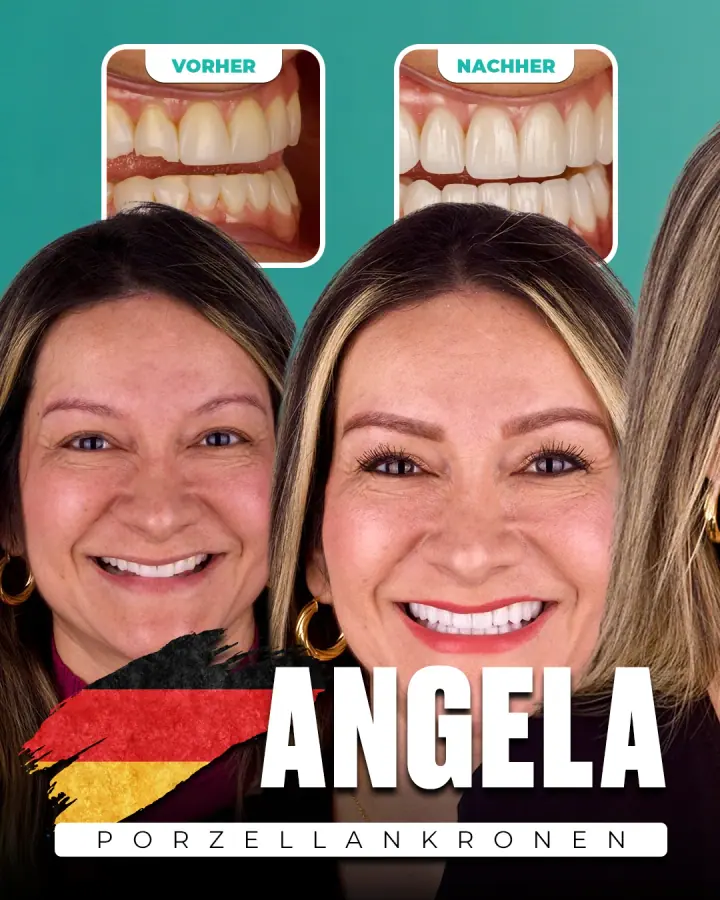
AngelaGermany · Porcelain crowns 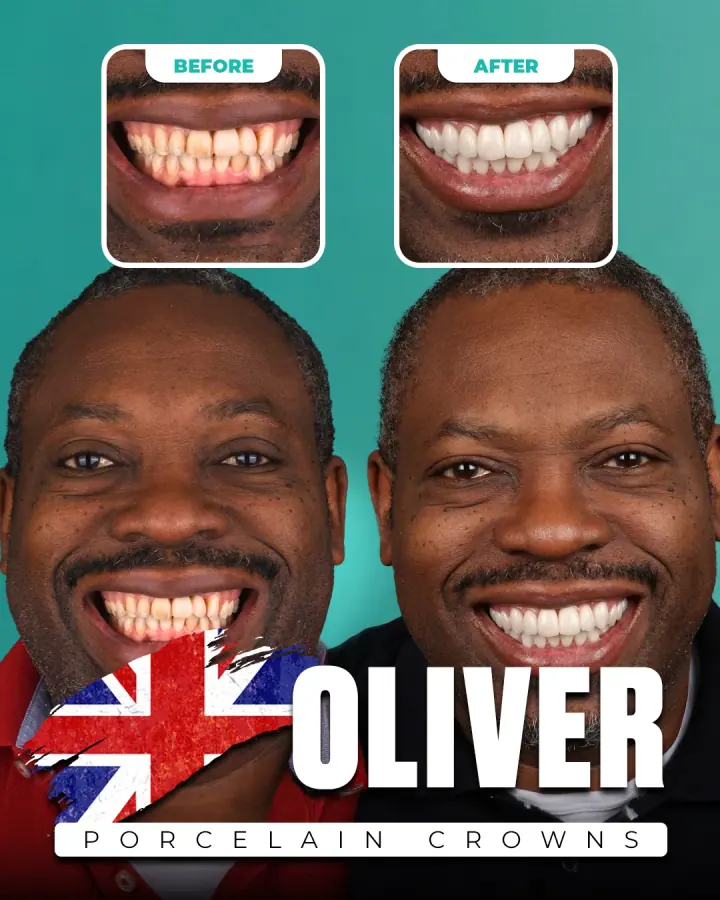
OliverUnited Kingdom · Porcelain crowns 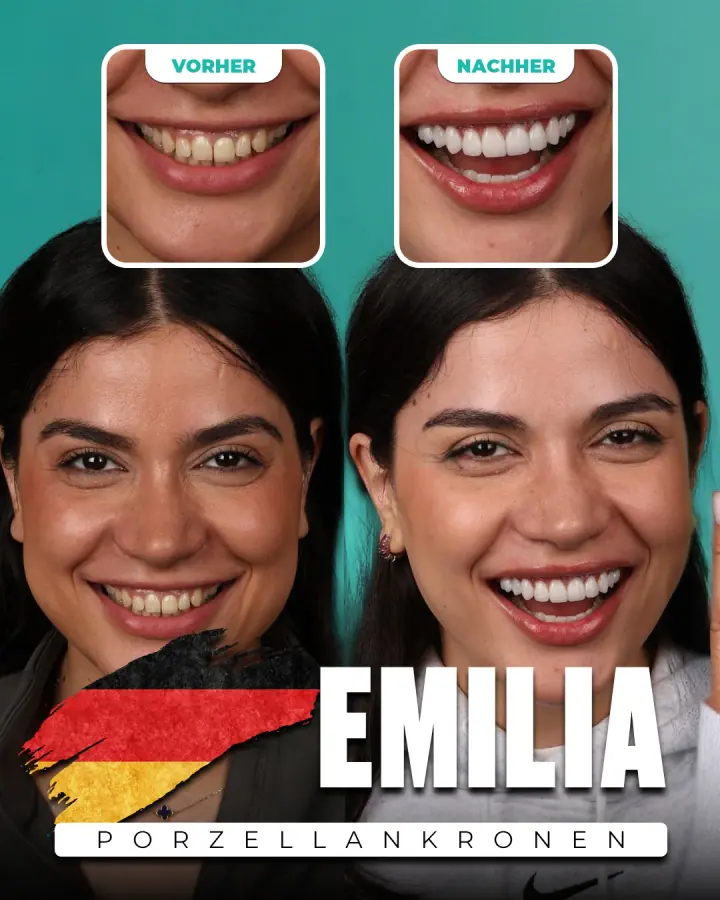
EmiliaGermany · Porcelain crowns 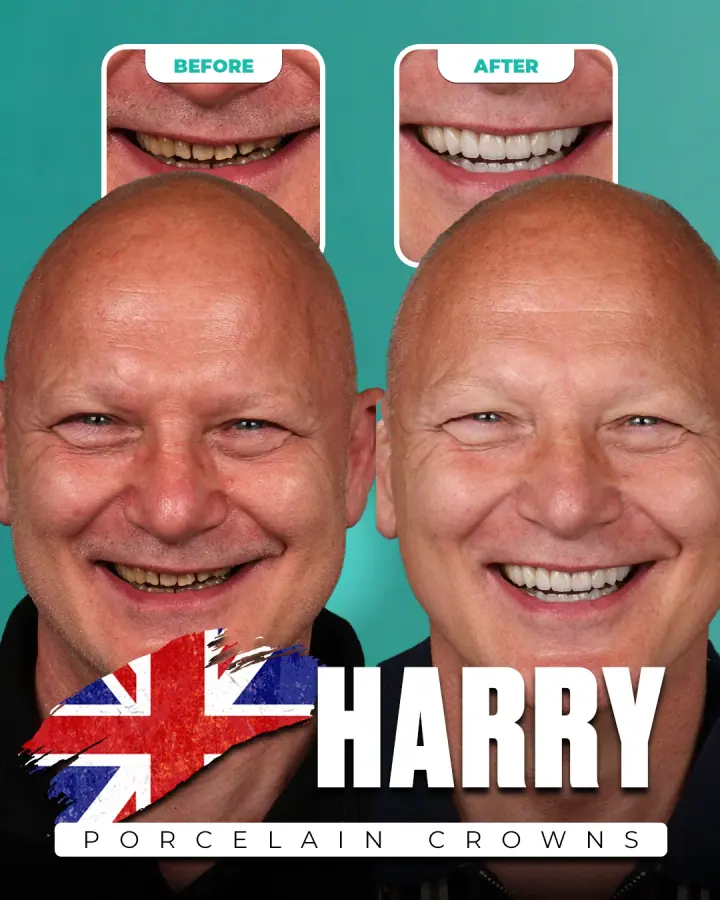
HarryUnited Kingdom · Porcelain crowns 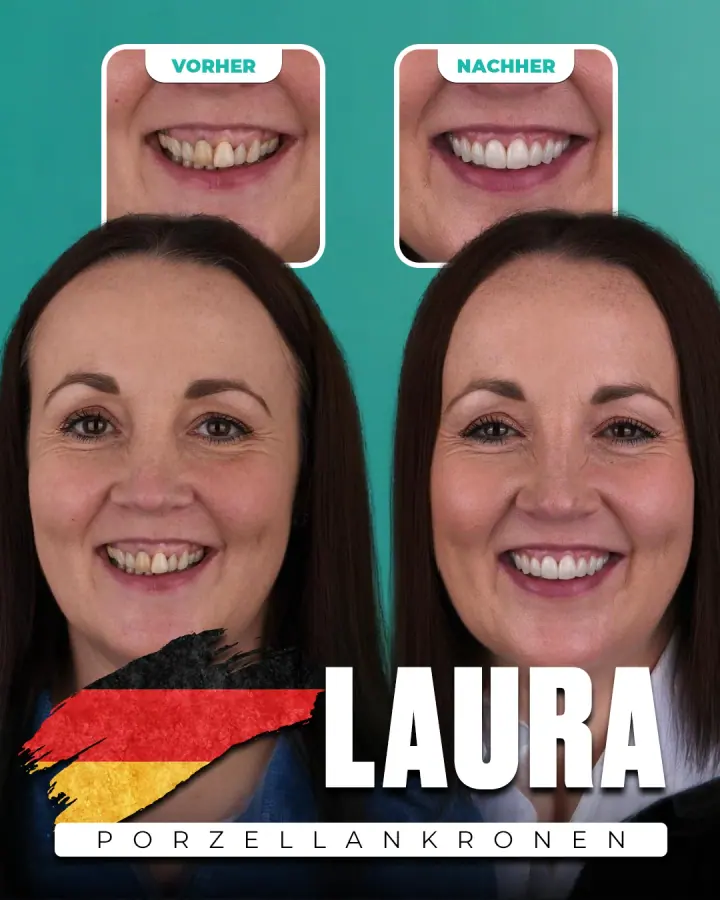
LauraGermany · Porcelain crowns 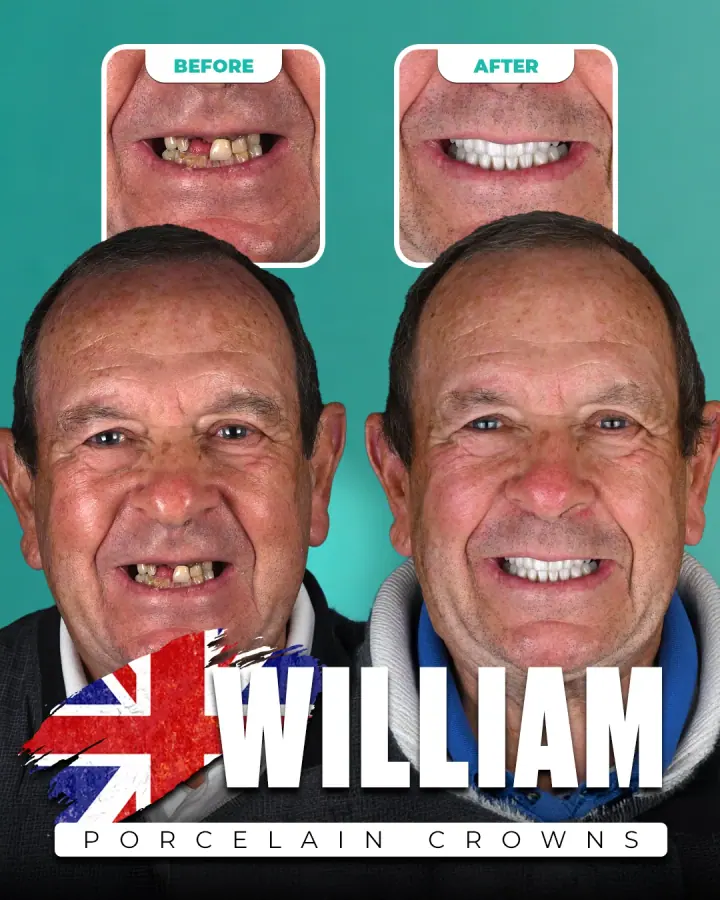
WilliamUnited Kingdom · Porcelain crowns


Treatment and Alanya
Crowns planned around your stay on the coast
Because a crown involves preparation, making and fitting, the visits are planned together with your travel dates once your dentist has examined the tooth. Any groundwork, such as root canal treatment, is built into that same plan.
How a dental holiday worksWhy Dental Art
What you can expect from us
Dentists in Alanya: Esra Namlı and Oğuz Ulutaş.
-
A plan before you book travel
Options, the likely number of appointments and what still depends on an examination — before flights are booked.
-
Five languages
The Dental Art group works in Dutch, English, German, Russian and Turkish, with practices in Alanya, Glanerbrug and Venlo.
-
One number throughout
WhatsApp +31 6 1508 6008 reaches the clinic before, during and after your visit.
-
Stay and transfers on request
Hotel stays and transfers between hotel and clinic can be arranged; what applies to you is confirmed in advance.
Ready when you are
Considering dental crowns? Start with a conversation.
Share what you would like to change and any recent X-rays or photographs. You will hear what is realistic, and what an examination would need to confirm.
Call +31 6 1508 6008Questions
Questions about dental crowns
If yours is not here, ask it directly. There is no obligation in asking.
Ask on WhatsAppDo I need a crown, or would a filling be enough?
That depends on how much sound tooth remains. A filling needs strong surrounding walls to support it; where too much structure has been lost, those walls may crack under chewing forces, and a crown or an onlay may protect the tooth better. Your dentist decides from the examination and X-ray, explains the reasoning, and tells you about any more conservative alternatives that could be considered.
How much of my tooth is removed?
Enough to give the crown material the thickness it needs to be strong, which varies with the material and the tooth. Some materials can be made thinner than others, and your dentist aims to remove no more than necessary. The preparation cannot be undone, which is why this is discussed with you before you agree to treatment.
Which crown material is right for me?
There is no single answer. Porcelain surfaces are often favoured on visible teeth where appearance leads, while zirconia is frequently chosen for back teeth, heavy bites and bridges. Grinding habits, the colour of the tooth underneath and the space available all play a part. Your dentist will propose a material for each tooth and explain why; the porcelain and zirconium crown pages go into more detail.
Will a crown look like my own teeth?
That is the aim. The shade and shape are agreed with you before the crown is made, and appearance is checked at fitting. Matching a single crown to natural front teeth is one of the more demanding tasks in restorative dentistry, so material choice and realistic expectations are discussed openly beforehand.
Can a crowned tooth still get decay?
Yes. The crown itself does not decay, but the tooth beneath it can, especially at the margin where crown and tooth meet near the gum. Brushing along that line, cleaning between the teeth daily and attending regular check-ups help to catch problems early, while they are still smaller to treat.
How long will a crown last?
There is no fixed answer, and no dentist can honestly promise one. How a crown holds up depends on the material, the tooth underneath, your bite, whether you grind, and how well the area is cleaned. Regular check-ups allow the margins and bite to be monitored, so that wear or leakage can be addressed early.
What happens between preparation and fitting?
A temporary crown protects the prepared tooth and holds the space while the final crown is made. Temporaries are fixed with a softer cement, so it is sensible to avoid sticky or very hard foods on that side and to clean gently around it. If it loosens or comes off, contact the clinic so it can be refixed.
Related treatments
Often considered alongside


