
Cosmetic dentistry
E-max Veneers in Turkey
Veneers made from lithium-disilicate glass-ceramic, valued for its enamel-like translucency.
Suitability depends on an individual clinical assessment — nothing is decided before you are examined.
Ask for a call back
Leave your name and number — the clinic calls you back.
Thank you. The clinic will call you.
Your number has reached the team in Alanya — your reference is . If it is easier, you can write on WhatsApp instead: Open WhatsApp
Your number could not be sent
Nothing was received, so please try again — your answers are still in the form.
About the treatment
A material choice within veneers
E-max veneers are made from lithium-disilicate glass-ceramic, a material known for its translucency and its strength relative to its thickness. They may be considered when a natural, light-transmitting appearance on front teeth is a priority; your dentist will assess whether the material suits your tooth colour, bite and case.

Light enters lithium-disilicate and scatters much as it does in enamel — the main reason to choose it.
“E-max” describes the material rather than a separate treatment. The veneers are made from lithium-disilicate, a glass-ceramic in which fine crystals sit within a glassy structure. That combination lets light enter and scatter in a way that resembles natural enamel, while giving the material more strength than traditional feldspathic porcelain of a similar thickness.
Because it is strong relative to its thickness, lithium-disilicate can be made quite thin, so it is used both for conventional veneers and, in suitable cases, for laminate-style designs with minimal preparation. It also bonds well to tooth structure. The same material is used for some crowns, which can help when veneers and crowns sit side by side and need to look consistent.
Its translucency is also its main limit. Light passes through, so the colour of the tooth underneath contributes to the final shade, and a very dark tooth may need a more opaque approach. For back teeth under heavy load, or where grinding is significant, another material such as zirconia may be recommended. Choosing the material is part of planning, not a default.
Who may consider it
Who may consider e-max veneers
E-max veneers are usually discussed when appearance is the main priority and the forces on the teeth are moderate.
Treatment suitability depends on an individual clinical assessment. Your dentist will discuss the options, risks and expected outcomes with you.
-
01
Front teeth seen in natural light
Incisors are thin and translucent at the edges, where an opaque material can look flat.
-
02
Matching neighbouring teeth
When only some teeth are treated, translucency helps new work blend with the natural teeth beside it.
-
03
Veneers and crowns side by side
Using one material for adjacent veneers and crowns can make shade and surface easier to coordinate.
-
04
Moderately discoloured teeth
Teeth that are not very dark allow the translucency of the material to work in your favour.

Benefits and considerations
What it can offer, and what to weigh up
Balanced information, because the right decision depends on both.
What it can offer
- Enamel-like translucencyLight passes into the material rather than stopping at the surface, which helps it read as tooth.
- Strength relative to thicknessIt can be made thin while remaining robust once bonded.
- Bonds to tooth structureThe adhesive bond supports both the veneer and the tooth beneath it.
- No metalThere is no metal layer to show as a dark line at the gum.
What to consider
- Underlying colour shows throughVery dark teeth may need a more opaque material, whitening first, or a different design.
- Not the answer for every toothHeavy bite forces or severe grinding may favour zirconia or another option.
- Preparation is usually neededAlthough thin designs are possible, most veneers need some enamel removed, and that cannot be undone.
- Repair has limitsSmall chips may sometimes be polished, but larger damage usually means replacing the veneer.


Step by step
How the process works
The steps resemble those for other porcelain veneers, with particular attention to the shade of the tooth underneath.

-
Step 01
Examination
Teeth, gums and bite are assessed, with X-rays where needed, and any disease is treated first.
-
Step 02
Shade assessment
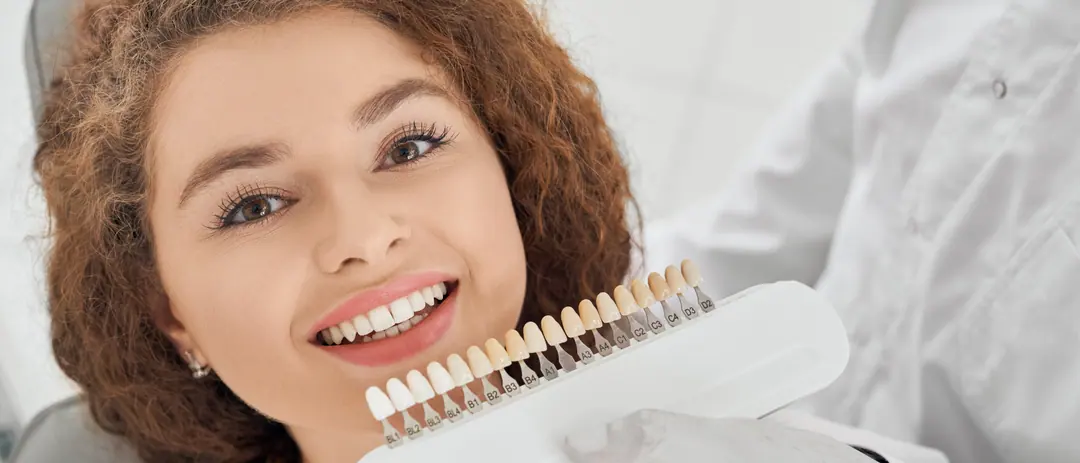
The natural tooth colour is recorded in good light, because the material will partly transmit it.
-
Step 03
Design and material choice
Shape and proportion are agreed with you, and your dentist confirms whether lithium-disilicate suits your case.
-
Step 04
Preparation and impressions
Enamel is prepared only as far as the design requires, under local anaesthetic if needed, and impressions are taken.
-
Step 05
Try-in
The veneers are checked for fit, shape and colour before anything is bonded.
-
Step 06
Bonding and review
Each veneer is bonded, the bite is checked and adjusted, and aftercare is explained.
Worth knowing
Worth knowing about lithium-disilicate
A few practical points that often come up when this material is discussed.
-
01
A material, not a treatment
“E-max” is the name widely used for lithium-disilicate restorations; the treatment itself is a veneer or a crown.
-
02
Compared with zirconia
Zirconia is stronger and more opaque and is often chosen for back teeth; lithium-disilicate is more translucent and usually favoured at the front.
-
03
Compared with composite
Composite can be added to and repaired in the chair but stains more easily; glass-ceramic resists staining better.
-
04
Shade is chosen at the start
Glass-ceramic does not respond to whitening, so any whitening of natural teeth is usually done first.
-
05
Grinding needs discussion
If you clench or grind, your dentist may suggest a night guard or a different material.


Treatment and Alanya
Translucent ceramic, judged in coastal daylight
Shade is assessed in good light and checked again at try-in, so the sequence allows time between preparation and fitting. Your dentist will explain how this fits around your stay once your case has been examined.
How a dental holiday worksWhy Dental Art
What you can expect from us
Dentists in Alanya: Esra Namlı and Oğuz Ulutaş.
-
A plan before you book travel
Options, the likely number of appointments and what still depends on an examination — before flights are booked.
-
Five languages
The Dental Art group works in Dutch, English, German, Russian and Turkish, with practices in Alanya, Glanerbrug and Venlo.
-
One number throughout
WhatsApp +31 6 1508 6008 reaches the clinic before, during and after your visit.
-
Stay and transfers on request
Hotel stays and transfers between hotel and clinic can be arranged; what applies to you is confirmed in advance.
Ready when you are
Considering e-max veneers? Start with a conversation.
Share what you would like to change and any recent X-rays or photographs. You will hear what is realistic, and what an examination would need to confirm.
Call +31 6 1508 6008Questions
Questions about e-max veneers
If yours is not here, ask it directly. There is no obligation in asking.
Ask on WhatsAppIs e-max a treatment or a material?
A material. “E-max” is the name commonly used for restorations made from lithium-disilicate glass-ceramic. The treatment is a veneer or, in some cases, a crown; the material is chosen for its translucency and its strength relative to its thickness. Veneers as a category, and laminates, which describe how thin a veneer is, have their own pages.
How are e-max veneers different from other porcelain veneers?
“Porcelain” is often used loosely for any dental ceramic. Traditional feldspathic porcelain can look very natural but is more fragile before bonding. Lithium-disilicate is a glass-ceramic whose crystalline structure makes it stronger at the same thickness while keeping good translucency. Which is preferable depends on your teeth, bite and aesthetic goals, and your dentist will explain the reasoning.
Can e-max veneers cover a dark tooth?
Up to a point. Because the material lets light through, the colour underneath affects the result. Mild to moderate discolouration can often be managed with careful shade selection, but a very dark tooth may need a more opaque ceramic, whitening beforehand, or a different design. This is assessed before any preparation takes place.
Are e-max veneers strong enough?
For front teeth under normal biting forces, bonded lithium-disilicate is generally considered a robust choice. Strength also depends on how much enamel there is to bond to, the design of the veneer and your habits. If you grind heavily or the veneer would sit under strong forces, your dentist may suggest a night guard or another material.
Is e-max better than zirconia?
Neither is better in general; they suit different situations. Lithium-disilicate is more translucent and bonds well, so it is often favoured for veneers on front teeth. Zirconia is stronger and more opaque, and is frequently chosen for crowns on back teeth or where bite forces are heavy. Your dentist will recommend a material based on the tooth in question.
What happens if an e-max veneer chips?
Very small chips can sometimes be smoothed and polished. Larger chips or fractures usually mean the veneer needs to be replaced, because glass-ceramic cannot be built back up in the mouth the way composite can. Regular check-ups, avoiding biting very hard objects and wearing a night guard if advised all help reduce the risk.
Related treatments
Often considered alongside


