
Restorative dentistry
Porcelain Crowns in Turkey
A crown with a porcelain surface, chosen when colour, texture and light matter most.
Suitability depends on an individual clinical assessment — nothing is decided before you are examined.
Ask for a call back
Leave your name and number — the clinic calls you back.
Thank you. The clinic will call you.
Your number has reached the team in Alanya — your reference is . If it is easier, you can write on WhatsApp instead: Open WhatsApp
Your number could not be sent
Nothing was received, so please try again — your answers are still in the form.
About the treatment
Why porcelain is chosen for visible teeth
A porcelain crown covers a weakened tooth with a ceramic surface that can be shaded and textured to sit quietly beside natural teeth. It is most often considered for teeth that show. Whether porcelain suits your tooth and bite is decided at an individual clinical assessment.

Porcelain is chosen for how it handles light; your bite decides whether it is the right choice.
Natural teeth are not a single flat colour. They are more opaque towards the gum and more translucent towards the biting edge, with fine surface texture that scatters light. Porcelain can be built up in layers of different shade and translucency to imitate that, which is why it has long been used where a crown has to sit beside natural teeth without drawing attention to itself.
The term “porcelain crown” covers more than one design. In a porcelain-fused-to-metal crown, porcelain is layered over a thin metal framework that provides strength. In an all-ceramic crown there is no metal: ceramic forms the whole crown, or porcelain is layered over a ceramic core, so light can pass through it more like a natural tooth. Each design has situations it suits, and your dentist will explain which is proposed.
Porcelain’s qualities in appearance are balanced by how it behaves under load. Layered porcelain can chip if a tooth takes heavy biting forces, or if you grind or clench. For that reason your dentist looks closely at your bite before recommending it, and may suggest zirconia or another material for back teeth, while keeping porcelain for the teeth that show when you smile and speak.
Who may consider it
Who may consider porcelain crowns
Porcelain crowns are usually discussed for teeth that show when you smile or speak. Your dentist will assess whether the tooth and your bite suit this material.
Treatment suitability depends on an individual clinical assessment. Your dentist will discuss the options, risks and expected outcomes with you.
-
01
A front tooth needing full coverage
Where a tooth is too damaged for a veneer or filling, and appearance is an important part of the decision.
-
02
Older crowns that no longer blend in
Crowns that now look different from neighbouring teeth, or show a dark line at the gum, may be reviewed.
-
03
A discoloured, root-treated front tooth
Where the tooth also needs structural protection, a crown can cover the discolouration as well as protect the tooth.
-
04
A moderate bite
Porcelain tends to suit teeth that are not under very heavy load and where grinding is not a concern.

Benefits and considerations
What it can offer, and what to weigh up
Balanced information, because the right decision depends on both.
What it can offer
- Depth of colourLayering allows shade and translucency to vary across the crown, as they do on a natural tooth.
- Surface textureFine texture and glaze can help the crown reflect light like the teeth beside it.
- Resistance to stainingGlazed porcelain resists surface staining better than natural enamel.
- Metal-free designs availableAll-ceramic crowns avoid the grey edge that can appear at the gum with metal-based crowns.
What to consider
- Chipping under heavy loadLayered porcelain can chip with grinding, clenching or very heavy bites, so the bite is assessed first.
- Tooth preparationThe tooth is reduced all round to make room for the crown, which cannot be reversed.
- Metal-based designs and the gumIf the gum recedes, the metal edge of a porcelain-fused-to-metal crown may become visible.
- Not always the right materialFor back teeth or people who grind, zirconia may be recommended instead.


Step by step
How the process works
Because appearance is central, shade and design receive particular attention. The crown is usually completed over more than one visit.

-
Step 01
Examination and X-ray
The tooth, root and supporting bone are assessed, along with your bite and any grinding habits.
-
Step 02
Design choice
Your dentist explains whether a metal-based or an all-ceramic design is proposed, and why.
-
Step 03
Shade selection
The shade is matched to your neighbouring teeth, ideally in natural light, with translucency and texture noted.
-
Step 04
Preparation and impression
Under local anaesthetic, the tooth is shaped and an impression is taken.
-
Step 05
Temporary crown
A temporary crown protects the tooth and fills the space while the porcelain crown is made.
-
Step 06
Try-in and fitting
Colour, shape, fit and bite are checked against your own teeth before the crown is cemented or bonded.
-
Step 07
Review
The bite is re-checked and cleaning around the crown margin is explained.
Side by side
Porcelain fused to metal or all-ceramic
Both designs have a porcelain surface. What sits underneath changes how the crown looks and how it behaves.
| Porcelain fused to metal | All-ceramic | |
|---|---|---|
| Structure | Porcelain layered over a thin metal framework | Ceramic throughout, with no metal |
| Light through the crown | Blocked by the metal, which must be masked | Passes through more like natural enamel |
| At the gum line | A dark edge may show if the gum recedes | No metal edge to show |
| Often considered for | Some bridges and teeth under heavier load | Visible teeth where appearance leads |
| Points to discuss | Any known sensitivity to metals | Biting load and grinding habits |

Real results
Cases the clinic has shared: porcelain crowns
Each image is the clinic’s own before-and-after composite, shown exactly as supplied. Results vary between patients and depend on an individual clinical assessment.
See all before and after casesMore results on Instagram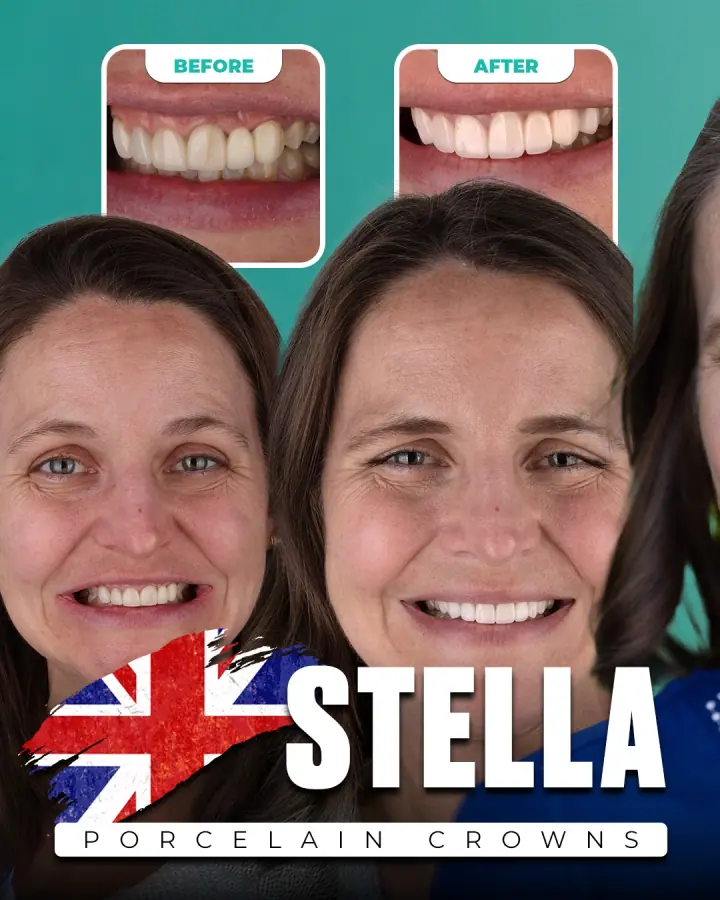
StellaUnited Kingdom · Porcelain crowns 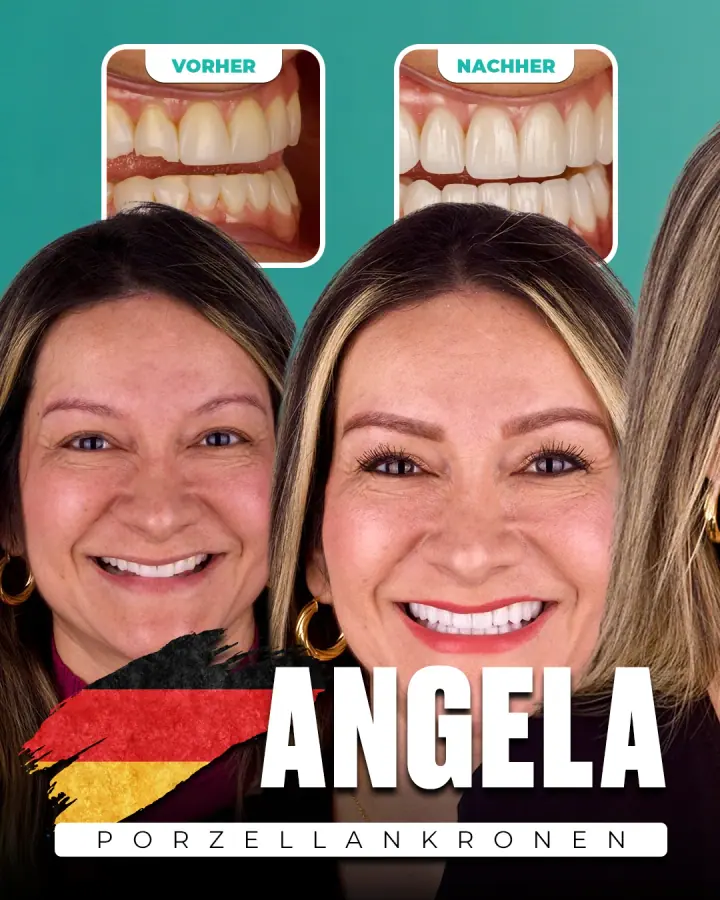
AngelaGermany · Porcelain crowns 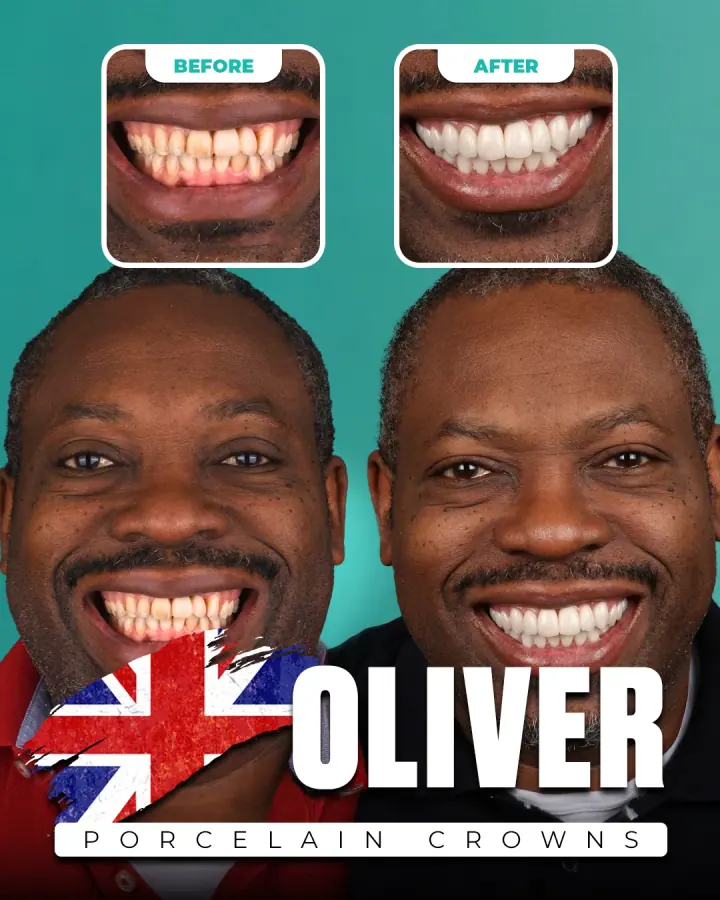
OliverUnited Kingdom · Porcelain crowns 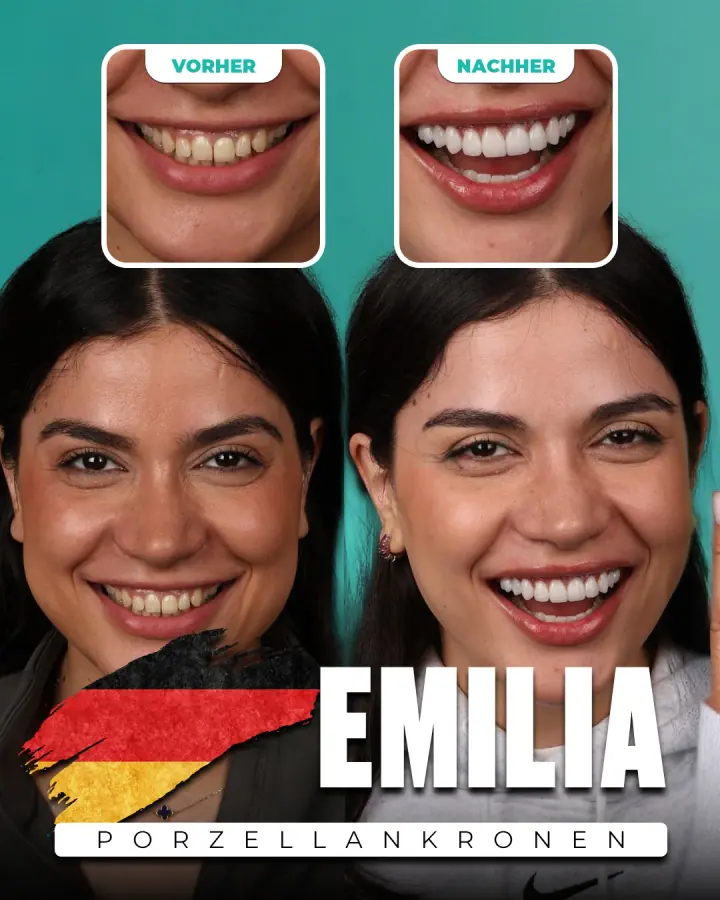
EmiliaGermany · Porcelain crowns 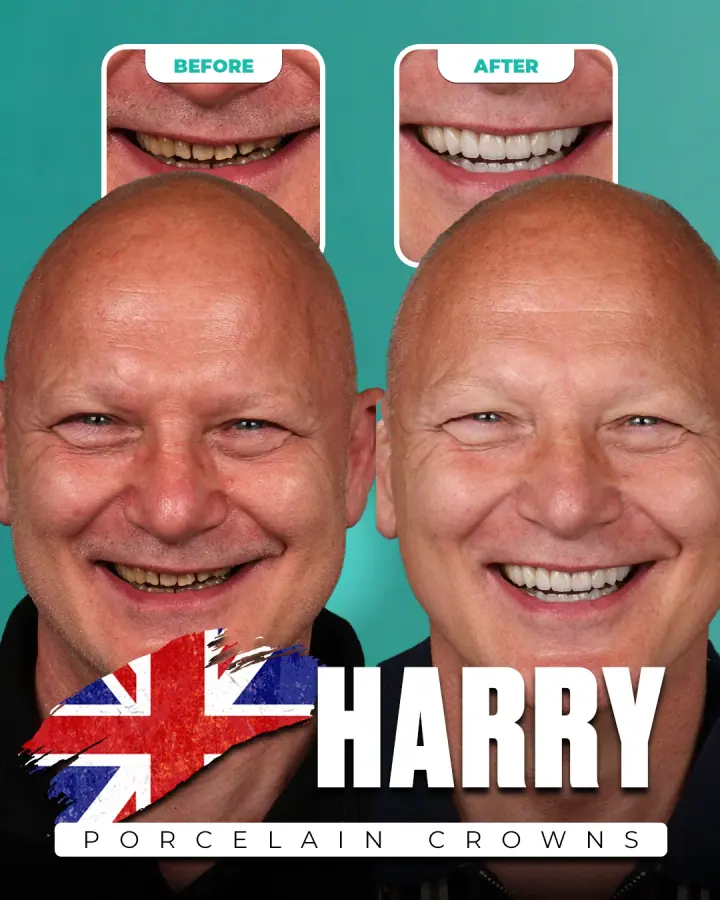
HarryUnited Kingdom · Porcelain crowns 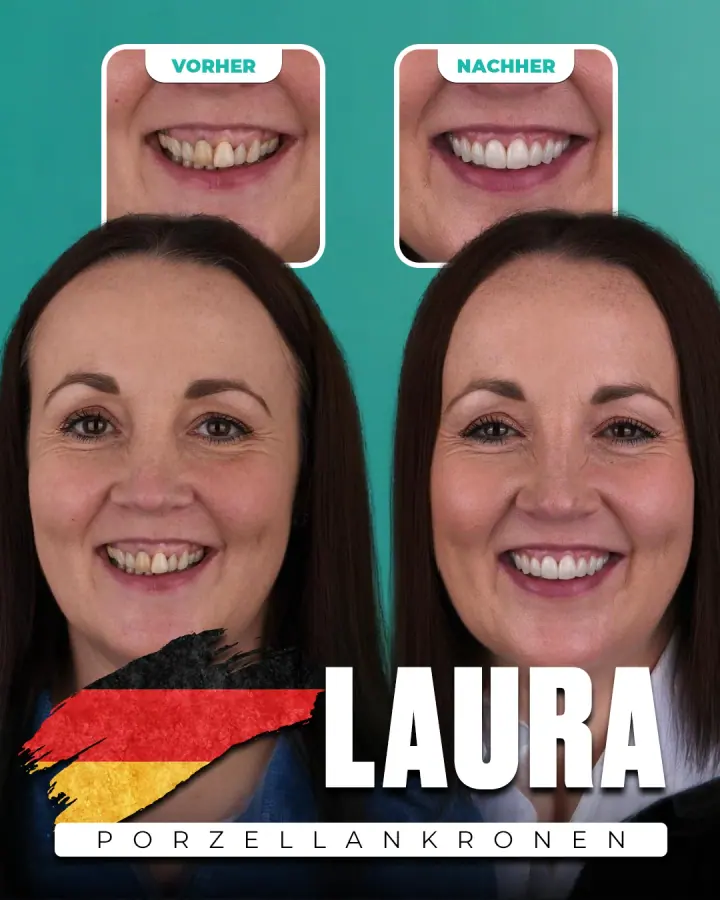
LauraGermany · Porcelain crowns 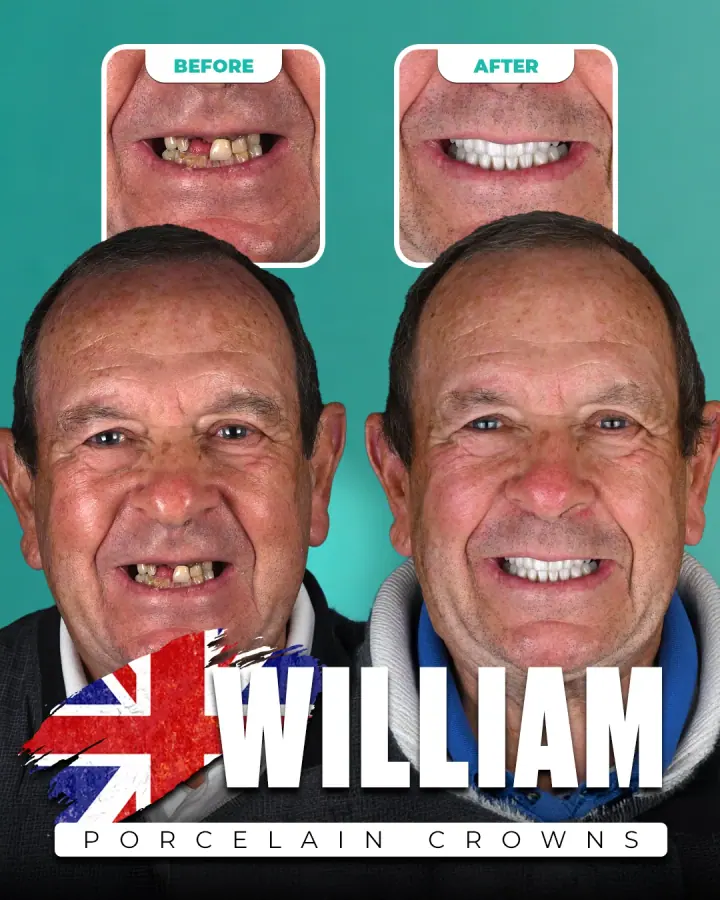
WilliamUnited Kingdom · Porcelain crowns


Treatment and Alanya
Porcelain shade chosen in Alanya’s daylight
Shade is chosen in natural daylight where possible, and the try-in is planned before the crown is finally fitted. Your visits are arranged around your travel dates once the examination has confirmed the plan.
How a dental holiday worksWhy Dental Art
What you can expect from us
Dentists in Alanya: Esra Namlı and Oğuz Ulutaş.
-
A plan before you book travel
Options, the likely number of appointments and what still depends on an examination — before flights are booked.
-
Five languages
The Dental Art group works in Dutch, English, German, Russian and Turkish, with practices in Alanya, Glanerbrug and Venlo.
-
One number throughout
WhatsApp +31 6 1508 6008 reaches the clinic before, during and after your visit.
-
Stay and transfers on request
Hotel stays and transfers between hotel and clinic can be arranged; what applies to you is confirmed in advance.
Ready when you are
Considering porcelain crowns? Start with a conversation.
Share what you would like to change and any recent X-rays or photographs. You will hear what is realistic, and what an examination would need to confirm.
Call +31 6 1508 6008Questions
Questions about porcelain crowns
If yours is not here, ask it directly. There is no obligation in asking.
Ask on WhatsAppHow is a porcelain crown different from a zirconium crown?
The main difference is the material and what it is chosen for. A porcelain crown uses layered porcelain on its surface, which can closely imitate the translucency and texture of natural enamel. A zirconium crown is made of zirconia, a denser, stronger metal-free ceramic that is often chosen for back teeth and heavy bites. It is common to have both, in different parts of the mouth.
Is a porcelain crown the same as a veneer?
No. A veneer is a thin shell bonded to the front surface of a tooth, and the preparation is usually more limited. A crown covers the whole visible tooth and is used where the tooth needs structural protection, not only a change in appearance. Your dentist will explain which is more appropriate for the amount of damage present.
Does a porcelain crown contain metal?
It depends on the design. A porcelain-fused-to-metal crown has a thin metal framework beneath the porcelain, while an all-ceramic crown has none. Your dentist will tell you which design is proposed and why. If you have a known sensitivity to metals, or a clear preference, mention it at the consultation so it can be taken into account.
Can porcelain chip or crack?
It can. Porcelain is hard but relatively brittle, and it may chip under very heavy biting forces, if you grind or clench, or if you bite on something very hard. This is why your bite is assessed before porcelain is recommended. If you grind your teeth, a protective night guard may be suggested once the crown is fitted.
Will a porcelain crown stain or change colour?
Glazed porcelain resists staining better than natural enamel, so coffee, tea and red wine tend to affect it less. It will not, however, lighten if you whiten your natural teeth later. If whitening is something you are considering, it is usually sensible to complete it before the shade of the crown is chosen.
How do I look after a porcelain crown?
Much like a natural tooth: brush twice a day with a soft brush and a non-abrasive toothpaste, and clean between the teeth daily, paying attention to the margin near the gum. Avoid using the crown to open packaging or to bite very hard objects, and keep up regular check-ups so the crown and the tooth beneath it can be monitored.
Related treatments
Often considered alongside


